
"
Infrastructure alone wouldn’t have prevented conflict; repairing relationships did.
Michael Afolami is a strategic innovation consultant designing and implementing large-scale programmes across the nonprofit, public, and private sectors. He is a former Youth Engagement Coordinator for Sub-Saharan Africa, he engages with regional networks of youth-led civil society to ensure that the needs and priorities of young peacebuilders are reflected in Investing and Partnering with Youth for Peace (IPYP). In this role, he also works on linking young peace innovators with the resources and partnerships they need to sustain their work and expand their impact.

Everyone agrees that prevention is cheaper than response. But in a conference room filled with development financiers at the Africa Resilience Forum (ARF), I began to wonder: cheaper for whom? I was there to moderate a session on outcomes-based finance for youth-led peacebuilding, and given the forum's theme, "Prioritizing Prevention: Financing Peace in a Changing Development Cooperation Landscape," I expected consensus on financing systems that prioritise prevention and finance peace initiatives that address the root causes of conflict. Instead, I found myself asking questions about who gets to decide what counts as prevention, which peace to finance, and who pays.
These questions offer a way forward, suggesting that prevention must be redesigned collaboratively to be effective. This is what made the session on Outcomes-Based Finance, led by Investing and Partnering with Youth for Peace (IPYP), not only powerful but also exemplary. It reflected a longstanding co-design effort between the African Development Bank (AfDB), youth, and civil society, and reflecting the diversity of voices in the room who shaped the conversation on the potentials of peace outcomes financing. Co-designing prevention creates space for both financial accountability and local innovation, thereby reducing financing risks and sustaining prevention funding and outcomes.
The forum was timely because as Simon Winter, Vice President of the Rockefeller Foundation, shared: ‘Only 1% of humanitarian crisis funds are deployed in anticipation. 99% arrive after crises erupt’. And we know that every $1 invested in conflict prevention returns can generate savings of $4 to $75, or even higher for countries in active conflict. We are essentially spending vastly more on response than prevention, despite prevention being cheaper and less destructive. This is why we must prioritise prevention, not only because it saves money but also because it improves quality of life by fostering more stable and secure societies.
Over two days at the forum, I frequently heard certain words repeated: peace-positive, finance, partnerships. They were all legitimate words. But one word that, although it wasn’t overused, piqued my interest was bankable. Given that the conversations centred around financing peace and prioritising prevention, I didn't expect bankability to be positioned as a criterion for financing. It introduces a risk lens into decisions about which peace or prevention project should be selected for financing. In development finance language, bankable means: Can investors predict returns? Can risk be managed? Can this scale? I understand the logic, these questions matter for institutional accountability. But here's the tension: the kinds of work that prevent crises may not have predictable returns. They may be deemed too risky or not scalable enough for investment. Investors recognise their impact, but hesitate because the returns aren't financial, the timelines are long, and the outcomes resist standardisation. As a result, such initiatives are often filtered out from financing through the lens of bankability.
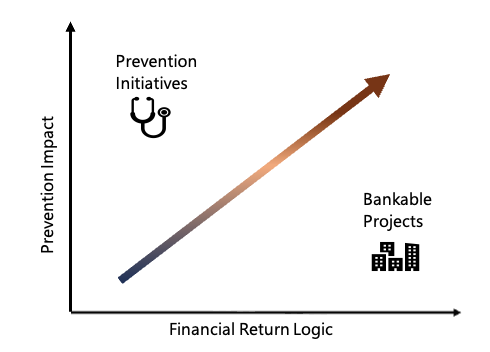
Current financing models prioritse predictability over prevention
Current financing models prioritse predictability over prevention
Practitioners at the forum shared examples of what builds peace: community-based early warning systems, youth-led dialogue platforms, locally rooted conflict resolution mechanisms, relationship-building that doesn't produce quarterly outputs, traditional knowledge systems, women's networks with enormous credibility but tiny budgets.
Take the example shared by Fatima Al Ansar, Founder and Executive Director at Tilwate Peace Network, who participated at our session. Before providing a water facility for her community in the Sahel, she recognised that she first had to resolve an existing intercommunal conflict to ensure that her intervention did no harm and prevented violent conflict.
You see, that sequencing mattered. Infrastructure alone wouldn't have prevented conflict; repairing relationships did. Such approaches don't scale predictably or generate clean donor data. By traditional standards, it looks risky. Yet it created conditions that sustain peace: trust between communities, local capacity to manage tensions, community ownership. These are the kind of approaches that sustain peace and prevent conflict from erupting and relapsing. The challenge is that existing financing structures often fail to recognise them as bankable.
Infrastructure alone wouldn’t have prevented conflict; repairing relationships did.
Financial accountability matters. Institutions managing public funds must demonstrate results. But something gets lost when financial metrics such as predictability and scalability become the primary lens for evaluating peace work, we risk overlooking the very work that sustains peace. This is a design problem that we can address if practitioners, youth leaders, and DFIs/IFIs co-designed frameworks that uphold bankable prevention: co-creating the language and structures needed to translate the outcomes of transformational peace work into financial thinking.
The Africa Resilience Forum presented a unique opportunity in this regard. It brought together the actors who need one another most: development banks, UN agencies, government officials, civil society organisations and youth activists. This convergence itself signals progress. If prevention financing is to work, these are the voices that must collaborate, and seeing them in dialogue creates genuine possibility.
The next step is to strenghten that collaboration from the design stage forward. Together, these actors can co-design peace finance instruments and de-risking metrics that meet institutional needs. The opportunity lies in building frameworks together from the beginning, where youth articulate how their prevention work de-risks contexts in terms that resonate with investment logic, and where financial actors learn what sustainable peace actually requires on the ground. When practitioners and financiers design together, rather than sequentially, we create solutions neither could achieve alone.
I left the forum convinced this design gap is closable. If we democratise the power to define what is worth funding to prevent conflict, then we can spend less money on responding to conflicts. Right now, outside the ARF rooms, prevention is still largely defined by those managing money, not by those preventing conflict. That gap matters for whose work gets funded, what approaches scale, and whether the resilience we build serves the people it's meant to protect.
The next step is to have conversations about prevention and finance differently. Not with practitioners translating work into donor language, but with all stakeholders co-creating the language itself. Not with youth seeking seats at tables designed by others, but with youth co-designing the tables. Not through consultation, but through co-leadership.
This is a chance to make peace not only funded, but financed, measurable, investable, and rewarded for real results. And that's the kind of bankable prevention worth building.
When practitioners and financiers design together, rather than sequentially, we create solutions neither could achieve alone.